UPDATE: I have updated the post by adding some points from Peter Todd at the bottom. The rest of the post remains as originally written.
I have enough posts on Bitcoin that it should be obvious that I am "pro" Bitcoin. But I am also a skeptic, and I seek out evidence of my beliefs being wrong. It's the only way to minimize mistakes in life. Unfortunately for my Bitcoin fandom, most of Bitcoin's critics either don't understand how Bitcoin works or they don't understand the current banking system well. Or both! But I have just read what I think is the most cogent and convincing critique of Bitcoin's limitations from the Clearmatics blog.
Now, Clearmatics is in the distributed ledger space, and they have a product that competes with Bitcoin. So some might dismiss their arguments as motivated reasoning. But that would be foolish. The argument, evaluated on its own merits, is quite sound.
The core insight of Clearmatic's argument is that colored coins are technically possible but it would be a disaster to implement them at significant scale. The reason is that Bitcoin's ledger is not protected by cryptography. Bitcoin is protected by game theory, and colored coins change the rules of the game.
The Bitcoin network is maintained and verified by its miners. The miners compete against each other to verify blocks of transactions and add them to Bitcoin's block chain. Anyone can set up a miner and start broadcasting blocks though, including fraudulent blocks. To defend against this sort of fraud, Bitcoin's nodes and wallets follow the rule that whichever block chain is longer is deemed authoritative, and to ignore all other block chains. It is merely assumed that miners are too diverse to coordinate a conspiracy against the network, and thus non-conspirators always have more aggregate computing power than any one fraudster, and thus the non-conspirators' blockchain is always longest. Fraud is thus ignored.
This breaks down though if a fraudster ever amasses computing power equal to all other miners globally, plus 1%. If the fraudster's computing power is equal to 51% of more of the global network as a whole, then the fraudster's miners will produce blocks faster than the "honest" miners, and the rest of the bitcoin ecosystem (the nodes and wallets) will switch from the honest blockchain to the fraudulent blockchain. This is called a 51% attack.
51% attacks don't happen though, because the expense of doing so outweighs any benefit. The most recent figure I saw was that the cost of a 51% attack would be about $110 million. Since a 51% attack would destroy the value of Bitcoin itself (the only asset currently on the Bitcoin network), there really isn't a way to extract $110 million from the Bitcoin network before the fraud is discovered and the fraudulent blockchain abandoned by the nodes. Thus a 51% attack is always a money-losing proposition.
There are two scenarios where this game theory breaks down, one of which I have been aware of for some time. One fear I've had for a while is that a government will attack Bitcoin if it's ever deemed to be a threat to their national interest. A lot of Bitcoin's miners are already in China, for instance. If the government there deemed Bitcoin to be a material threat to their capital controls or financial system, it could seize the miners there and coordinate their efforts to assemble a 51% attack against the network. This is a theoretical threat though, and I'm not sure it would ever happen.
Clearmatics' point though is that as soon as you start using colored coins in any serious way, the payoffs of a 51% attack change. For instance, there's roughly 5.8 billion shares of APPL outstanding, so if you assigned one share per Satoshi, you'd only need 58 BTC to list the entire APPL market cap on bitcoin. And that's just one company. Global debt and equity markets have many trillions in value. You could even color Satoshis to represent large blocks of currency (say 10 million USD or EUR each) to handle daily settlements between banks.
At those prices, a $110M investment in taking control of the settlement network becomes profitable. Anyone who can track down the various miners operating the mining pools today can coordinate them into a 51% attack, transfer several billion dollars into various accounts, and then de-coordinate the miners so that the new blockchain continues forward as the "real" one.
Boom. Bitcoin is done for colored coins. The fact that this risk exists at all means no one should adopt it for this use case.
I'm still a fan of Bitcoin for what it is, but as long as this risk exists I don't think colored coins (at least for financial market use) are in its future. Perhaps they're still useful for things like door locks and rental cars, but only because those items are also too small (or too hard to aggregate a theft of) to make a 51% attack profitable. Nakamoto's design-goal of censorship resistance was achieved, but at the price of not being trustworthy with assets of significant value.
UPDATE: I reached out to Peter Todd via Twitter, and he was kind enough to respond to my queries. I think the strongest point he made is that if there is ever $trillions of value on the Bitcoin network in the form of colored coins, that would make higher mining fees possible. Users would still be paying a small percentage of their overall assets for the secure transfer, so that's bearable, and, as Peter put it, 1% of several trillion would pay for a lot of mining security.
On the other hand, in order to get higher fees, the maximum block size has to remain small. Users compete for access to block confirmations by paying fees to the miners. If blocks are too large though, there's no competition to get into them, and users can get away with paying a small fee or no fee at all. In the future as the mining reward of new Bitcoins becomes smaller over time, only miner fees would pay for mining operations. Those fees would have to be pretty high to pay for a secure network. Thus getting to trillions in value exchange is a more-or-less necessity for Bitcoin to be a viable and secure network over the long term.
I don't envy the careful balancing act the core developers must navigate to get there.
Tuesday, June 16, 2015

Monday, June 8, 2015
Colored Coins are here
Last November I wrote an "explainer" for Coin Center on the topic of colored coins. The basic gist of the article is that Bitcoins are a digital commodity which can be traded themselves and have a market value, but they're also a bit like blank piecea of paper. Any other financial instrument (cash, equity, debt, REIT, etc.) can be printed on them, and then traded via the blockchain. Back when I wrote the article this was more theoretical than practical, but technology and business have advanced in the last seven months. A few items-
NASDAQ has announced an experiment with private company stock on the blockchain. This means that private companies, when they issue shares to employers or early stage investors, will do so by sending the shares to a Bitcoin wallet that is colored coin compliant. The employees can also redeem their shares, or trade them on authorized secondary markets, using the same technology.
Overstock has issued their first debt instrument on the blockchain. The debt issuance this time around is limited to accredited investors, but that's a restriction of the US securities laws, not the technology. If this proves successful as a means of debt issuance, a very large market could be captured by bitcoin.
LHV Bank in Estonia has issued Euros on the blockchain. These bank obligations are supposed to be a cash substitute for local payments, to directly compete with the credit and debit card networks. Although technically not cash (because only the European Central Bank can issue Euros, and they haven't issued any to the blockchain) this instrument is probably most usefully thought of a money market fund share that trades at par. It's 1 Euro. According to the lead developer of this project, this is currently in a test phase with only 100,000 EUR in liquidity.
These are significant developments for the Bitcoin network, and address one of the key issues with widespread adoption. Among the issues that currently put Bitcoin at a disadvantage relative to the card networks or bank payments, are the volatility of the bitcoin price and the need to trade out of the bitcoin network after each transaction in order to have a currency that's commonly accepted in your local economy. With colored coins, both of those objections go away. Colored coins use only a de minimus amount of Bitcoin (fractions of a penny) to mark their value on the blockchain, so their market value is always equal to whatever financial instrument they represent (1 Euro, a $1000 bond, etc.). When you receive 53 Euro via colored coins, you have 53 Euro, and that doesn't fluctuate in your local currency (Euros).
Volatility - gone.
Need to trade off of Bitcoin to get a useful local asset - gone.
Further, colored coins keep the primary benefit of bitcoin transactions, which is irreversibility. When a merchant accepts bitcoins, it's just as much his as if he accepted cash. The customer may seek a refund for some reason, but that refund will be decided by the merchant or a Court of law, not the credit card processor. This produces a great deal of certainty which will be very attractive to merchants. "As final as cash" is a good marketing slogan for merchant adoption.
The two remaining stumbling blocks, as I see it, are privacy and fast transaction time. Let's deal with the second of those issues first.
Credit and debit card networks confirm their transactions fairly quickly, usually on the order of a few seconds (ignoring the chargeback issue). Bitcoin blocks are only confirmed on average every 10 minutes, and you want at least three confirmations to be fairly certain the transaction is accepted. This is probably fine for selling your privately held equity back to your employer, as in the NASDAQ example above, but it's obviously unacceptable for everyday shopping at the grocery store or pub.
Thankfully I think this issue will be solved thanks to the Lightning network. I'm not sure how long it will take the Lightning network to become active, but a lot of the core devs support the initiative and Cuber (the company behind LHV's Euro coins) plans to support it as soon as it's up and running. I consider this "fairly certain".
As for privacy, I'm not sure how to get there. The current network of banks and credit card companies isn't private from the banks or the government; they can see what you're doing. But at least your friends and neighbors can't. On Bitcoin, anyone can explore the blockchain. Here's the transaction for the first Overstock debt issuance, to their CEO. There are Bitcoin tumblers which provide some level of anonymity, but I'm not sure how they'd work with colored coins. You'd at least need a very liquid market in the instrument you're trading for it to work, which I guess is feasible for cash but I'm not sure about the other less liquid instruments. Those may just be a public record.
But be that as it may, I'm quite fascinated by the developments here. Essentially since the invention of banking in Venice, over-the-counter trading has been limited to bearer instruments (rare) or between banks. The idea of regular folks exchanging cash and other assets directly, over the Internet, without any institutional intermediary, and for only a nominal fee (fraction of a cent), is truly revolutionary. Not to be excessively hyperbolic, but this really will "change everything" about finance. It's a very exciting time to be alive.
NASDAQ has announced an experiment with private company stock on the blockchain. This means that private companies, when they issue shares to employers or early stage investors, will do so by sending the shares to a Bitcoin wallet that is colored coin compliant. The employees can also redeem their shares, or trade them on authorized secondary markets, using the same technology.
Overstock has issued their first debt instrument on the blockchain. The debt issuance this time around is limited to accredited investors, but that's a restriction of the US securities laws, not the technology. If this proves successful as a means of debt issuance, a very large market could be captured by bitcoin.
LHV Bank in Estonia has issued Euros on the blockchain. These bank obligations are supposed to be a cash substitute for local payments, to directly compete with the credit and debit card networks. Although technically not cash (because only the European Central Bank can issue Euros, and they haven't issued any to the blockchain) this instrument is probably most usefully thought of a money market fund share that trades at par. It's 1 Euro. According to the lead developer of this project, this is currently in a test phase with only 100,000 EUR in liquidity.
These are significant developments for the Bitcoin network, and address one of the key issues with widespread adoption. Among the issues that currently put Bitcoin at a disadvantage relative to the card networks or bank payments, are the volatility of the bitcoin price and the need to trade out of the bitcoin network after each transaction in order to have a currency that's commonly accepted in your local economy. With colored coins, both of those objections go away. Colored coins use only a de minimus amount of Bitcoin (fractions of a penny) to mark their value on the blockchain, so their market value is always equal to whatever financial instrument they represent (1 Euro, a $1000 bond, etc.). When you receive 53 Euro via colored coins, you have 53 Euro, and that doesn't fluctuate in your local currency (Euros).
Volatility - gone.
Need to trade off of Bitcoin to get a useful local asset - gone.
Further, colored coins keep the primary benefit of bitcoin transactions, which is irreversibility. When a merchant accepts bitcoins, it's just as much his as if he accepted cash. The customer may seek a refund for some reason, but that refund will be decided by the merchant or a Court of law, not the credit card processor. This produces a great deal of certainty which will be very attractive to merchants. "As final as cash" is a good marketing slogan for merchant adoption.
The two remaining stumbling blocks, as I see it, are privacy and fast transaction time. Let's deal with the second of those issues first.
Credit and debit card networks confirm their transactions fairly quickly, usually on the order of a few seconds (ignoring the chargeback issue). Bitcoin blocks are only confirmed on average every 10 minutes, and you want at least three confirmations to be fairly certain the transaction is accepted. This is probably fine for selling your privately held equity back to your employer, as in the NASDAQ example above, but it's obviously unacceptable for everyday shopping at the grocery store or pub.
Thankfully I think this issue will be solved thanks to the Lightning network. I'm not sure how long it will take the Lightning network to become active, but a lot of the core devs support the initiative and Cuber (the company behind LHV's Euro coins) plans to support it as soon as it's up and running. I consider this "fairly certain".
As for privacy, I'm not sure how to get there. The current network of banks and credit card companies isn't private from the banks or the government; they can see what you're doing. But at least your friends and neighbors can't. On Bitcoin, anyone can explore the blockchain. Here's the transaction for the first Overstock debt issuance, to their CEO. There are Bitcoin tumblers which provide some level of anonymity, but I'm not sure how they'd work with colored coins. You'd at least need a very liquid market in the instrument you're trading for it to work, which I guess is feasible for cash but I'm not sure about the other less liquid instruments. Those may just be a public record.
But be that as it may, I'm quite fascinated by the developments here. Essentially since the invention of banking in Venice, over-the-counter trading has been limited to bearer instruments (rare) or between banks. The idea of regular folks exchanging cash and other assets directly, over the Internet, without any institutional intermediary, and for only a nominal fee (fraction of a cent), is truly revolutionary. Not to be excessively hyperbolic, but this really will "change everything" about finance. It's a very exciting time to be alive.
Thursday, June 4, 2015
Buddy, can you spare a hand?
I was surprised this morning to see breathless headlines that a rat limb had been grown in a lab. I have been following the progress of synthetic organ generation, and to date the most advanced techniques I was aware of could only grow very thin organs like skin or bladder sacs or very small organ tissue samples, such as a small patch of liver cells suitable for drug testing but not transplant. I thought we were at least a decade away from growing full, complex organs such as a heart or kidney, and didn't even have an estimate for when we could grow something as complex as a limb (with all its various tissue types that need to connect to each other in just the right places). The ability to grow a limb would represent a quantum leap in technology.
Thus I was not surprised to learn, upon reading the paper, that they had in fact not grown a limb in the lab. Not entirely.
The chief challenge with growing artificial organs today is organizing the stem cells into the correct 3D shape. After all, an organ isn't an undifferentiated mass of cells. It has veins and arteries and functional systems that all need to be in the right place and aligned properly in respect of each other, or the thing doesn't work and quickly dies.
Currently there are three solutions for the above problem. The first one is to use a 3D-printer to "print" the cells into the correct place. This works okay for small tissue samples, but we haven't figured out how to print anything bigger than a couple millimeters. The second solution is to take a donor organ and wash away all its cells, leaving only the scaffolding (or "intercellular matrix") behind. This scaffolding can then be seeded with stem cells from the donee, and the cells (if cared for properly) will grow into the scaffolding like a vine growing up a trellis, forming a new organ. The third solution is a combination of the first two: 3D-print just the scaffolding, and then seed it with stem cells to grow in place.
This second method is how this rat limb was created. A donor limb was necessary, and then the seeded with cells. The advance (and it is a real advance) is that they were able to get all the different necessary tissues to grow nicely - bones, nerves, muscles, skin, etc. This is a good technological advance, but it doesn't free us from the need for organ donors. Alas.
The good news is that the 3D-printing of scaffolding, followed by seeding with stem cells, is coming along nicely. The most recent advance I could find quickly is the growth of this synthetic larynx. It's a promising technology that one day soon should free us from the need for organ donors entirely. But for now, limbs are still at least a decade away I'd guess.
Thus I was not surprised to learn, upon reading the paper, that they had in fact not grown a limb in the lab. Not entirely.
The chief challenge with growing artificial organs today is organizing the stem cells into the correct 3D shape. After all, an organ isn't an undifferentiated mass of cells. It has veins and arteries and functional systems that all need to be in the right place and aligned properly in respect of each other, or the thing doesn't work and quickly dies.
Currently there are three solutions for the above problem. The first one is to use a 3D-printer to "print" the cells into the correct place. This works okay for small tissue samples, but we haven't figured out how to print anything bigger than a couple millimeters. The second solution is to take a donor organ and wash away all its cells, leaving only the scaffolding (or "intercellular matrix") behind. This scaffolding can then be seeded with stem cells from the donee, and the cells (if cared for properly) will grow into the scaffolding like a vine growing up a trellis, forming a new organ. The third solution is a combination of the first two: 3D-print just the scaffolding, and then seed it with stem cells to grow in place.
This second method is how this rat limb was created. A donor limb was necessary, and then the seeded with cells. The advance (and it is a real advance) is that they were able to get all the different necessary tissues to grow nicely - bones, nerves, muscles, skin, etc. This is a good technological advance, but it doesn't free us from the need for organ donors. Alas.
The good news is that the 3D-printing of scaffolding, followed by seeding with stem cells, is coming along nicely. The most recent advance I could find quickly is the growth of this synthetic larynx. It's a promising technology that one day soon should free us from the need for organ donors entirely. But for now, limbs are still at least a decade away I'd guess.
Wednesday, June 3, 2015
Quantum Phenotype
This post continues a conversation I started on Twitter and Facebook regarding the biological basis of homosexual attraction. I have decided to respond here as long-form writing is really a better medium for discussing complex arguments. My primary interlocutor is JN, and this post will be addressed largely to him, but perhaps others will find it informative.
(Disclaimer: This post contains no political, ethical, moral, or religious conclusions. Any such insights the reader draws from it are their own. This post is simply my understanding of the current science.)
The start of this conversation was my assertion that sexual attraction is hard-coded into human physiology, and that culture/socialization may encourage or discourage our acting on that attraction, but culture cannot create a sexual orientation where none exists in the biology. My analogy for this is diet. A culture can influence what you eat, and how you eat, but only within the limits of a maximum possibility; it can't make you an herbivore. You just don't have the biology for it. JN's strongly held belief is that culture can in fact create homosexual attraction.
As a primary source, JN provided a link to this Columbia University paper which ruled out simple genetic and hormonal models of homosexual attraction, and posited that there must be socialization components to this behavior to cover the explanatory "gap" created by the genetic/hormonal explanations. Their primary reason for believing this was in opposite-sex twins (one boy, one girl) the boy was more likely to express homosexual attraction as an adolescent if he had no older brother, but showed the same odds of expressing homosexual attraction as anyone else if he did have an older brother. The presence of an older brother obviously cannot effect uterine environment or genetics, so the conclusion was that the older brother provided a social role model that guided the boy-twin away from homosexual attraction.
In opposition to this paper, Wikipedia provides a lengthy list of physiological markers which are different between gay and straight members of both genders. There are differences in brain structures, finger lengths, startle responses, handedness, hair-whorl direction, and so forth between gay and straight populations, and in many of these categories the homosexual shows characteristics associated with a heterosexual of the opposite gender. Put simply, there is no way culture or socialization can change the length of your fingers the shape of your cerebral lobes, especially so when this markers are present prior to birth. It is "unpossible".
So where does that leave us? The Columbia paper rules out a simple genetic explanation of homosexual attraction, and the existence of physiological markers rules out culture and socialization.
I believe that the Columbia paper is mistaken in two respects. Firstly, they only measure self-reported attraction, not biological markers. And secondly, they used the wrong model of how genetics work. I don't blame for that though, as the paper was written in 2001 and we have learned a lot about genomics in the last decade.
Firstly, let's dispense with the self-reporting. We've known since the Kinsey Study that as much as 10% of the population may engage in homosexual activity at least once during their adult years. Sexuality isn't an on/off switch between gay and straight; there's a range between the two, with individuals reporting a varying degree of bisexuality. It makes perfect sense that if a person is biologically bisexual (but not strongly so, maybe a 1 or 2 on the Kinsey Scale) that culture or socialization can influence whether they explore those feelings. That would explain entirely how birth order could affect self-reported feelings of attraction.
As for the genetic model, we have learned in the last decade that the old Mendel model of discrete genes is false. Craig Venter (who won the Human Genome Project prize by sequencing his own DNA, along with several others) had this to say about his own genetics:
Your DNA is your genotype. It says what's probable, but doesn't lock in hard-coded certainties in all respects. All it does it set the beginning state of an incredibly complex and self-organizing dance of molecules that turns two sex cells into a zygote and eventually a baby. But this process is not a fancy clock following set steps, it's a big messy chemistry bath subject to hormonal signals, uterine environment, and pure random chance.
By the time you're born though, the roulette wheels have all stopped spinning. Your cerebral lobes are either symmetrical, or not. Your index and ring fingers are either the same length, or not. There's no going back, and there's no socialization that will change them. To borrow an analogy from quantum physics, DNA is the quantum state of probability that existed before your conception, and your phenotype is the observed result - and thereafter fixed. The only thing society can do is encourage or discourage you from acting on your phenotype's existing and hard-coded predisposition to various behaviors.
Sidebar: What about the Greeks?
This section is primarily editorial in nature, and isn't based on much science (collecting firm data from 2,500 years ago just isn't possible). It addresses the point some people raise about how some societies (such as the Ancient Greeks) saw widespread homosexual activity, far greater than the 10% of the population found by the Kinsey Study to be at least partially bisexual. The argument here is that culture can in fact create homosexual attraction, despite everything I said above. I mean, haven't you read The Symposium by Plato?
Yes, I have. And I don't find Plato to be a trustworthy narrator. Rather than high-minded ideals of love and attraction, I'm reminded more of American prisons and NAMBLA apologists.
Among gays, there is a distribution of individuals who prefer top, bottom, and versatile positions during sex. There's no scientific consensus on what exactly the distribution is, or how culture may effect it, but the existence of these preferences are beyond dispute. I would call them "common knowledge" among the gay community, and I believe my gay friends when they tell me they have such preferences.
No such distribution is observed in the Ancient Greek tradition of paiderasteia. The older male is always the top, and the younger male always the bottom. If these were actual homosexual relationships the reverse would be true at least half the time. The practice of paiderasteia (both in Ancient Greece and in primitive tribes in Papa New Guinea, who have been studied by modern sociologists) is only consistent in my mind with institutionalized sexual abuse. The young men studied in primitive tribes show biological markers of abuse too, even where their culture say it's "Okay" for older men to do those things. They show stress markers, and are not engaging in the practice joyfully. If we had a time machine, I'd bet $1,000 we'd find the same among the Ancient Greeks.
The male sex drive is very strong, and if access to females is restricted (whether by the social rules of Athens, or because the male is locked up in prison, or because he's a shepherd alone with his sheep for weeks at a time), then it will find outlets by other means. The Ancient Greeks are only unique, in my mind, with the lengths they went to to romanticize and justify the practice.
(Disclaimer: This post contains no political, ethical, moral, or religious conclusions. Any such insights the reader draws from it are their own. This post is simply my understanding of the current science.)
The start of this conversation was my assertion that sexual attraction is hard-coded into human physiology, and that culture/socialization may encourage or discourage our acting on that attraction, but culture cannot create a sexual orientation where none exists in the biology. My analogy for this is diet. A culture can influence what you eat, and how you eat, but only within the limits of a maximum possibility; it can't make you an herbivore. You just don't have the biology for it. JN's strongly held belief is that culture can in fact create homosexual attraction.
As a primary source, JN provided a link to this Columbia University paper which ruled out simple genetic and hormonal models of homosexual attraction, and posited that there must be socialization components to this behavior to cover the explanatory "gap" created by the genetic/hormonal explanations. Their primary reason for believing this was in opposite-sex twins (one boy, one girl) the boy was more likely to express homosexual attraction as an adolescent if he had no older brother, but showed the same odds of expressing homosexual attraction as anyone else if he did have an older brother. The presence of an older brother obviously cannot effect uterine environment or genetics, so the conclusion was that the older brother provided a social role model that guided the boy-twin away from homosexual attraction.
In opposition to this paper, Wikipedia provides a lengthy list of physiological markers which are different between gay and straight members of both genders. There are differences in brain structures, finger lengths, startle responses, handedness, hair-whorl direction, and so forth between gay and straight populations, and in many of these categories the homosexual shows characteristics associated with a heterosexual of the opposite gender. Put simply, there is no way culture or socialization can change the length of your fingers the shape of your cerebral lobes, especially so when this markers are present prior to birth. It is "unpossible".
So where does that leave us? The Columbia paper rules out a simple genetic explanation of homosexual attraction, and the existence of physiological markers rules out culture and socialization.
I believe that the Columbia paper is mistaken in two respects. Firstly, they only measure self-reported attraction, not biological markers. And secondly, they used the wrong model of how genetics work. I don't blame for that though, as the paper was written in 2001 and we have learned a lot about genomics in the last decade.
Firstly, let's dispense with the self-reporting. We've known since the Kinsey Study that as much as 10% of the population may engage in homosexual activity at least once during their adult years. Sexuality isn't an on/off switch between gay and straight; there's a range between the two, with individuals reporting a varying degree of bisexuality. It makes perfect sense that if a person is biologically bisexual (but not strongly so, maybe a 1 or 2 on the Kinsey Scale) that culture or socialization can influence whether they explore those feelings. That would explain entirely how birth order could affect self-reported feelings of attraction.
As for the genetic model, we have learned in the last decade that the old Mendel model of discrete genes is false. Craig Venter (who won the Human Genome Project prize by sequencing his own DNA, along with several others) had this to say about his own genetics:
"I found out that I have a high probability of having blue eyes," the blue-eyed Venter said in a telephone interview.Craig Venter was born with blue eyes. They never changed to any other color at any point during his life. Culture and socialization had nothing to do with it, any more than it did the shape of his nose. But his DNA doesn't say for certain his eyes would be blue either, only that it was a probability. And this is the difference between genotype and phenotype.
"You can't even tell with 100 percent accuracy if I would have blue eyes, looking at my genetic code," he laughed. "We all thought that would be simple."
Your DNA is your genotype. It says what's probable, but doesn't lock in hard-coded certainties in all respects. All it does it set the beginning state of an incredibly complex and self-organizing dance of molecules that turns two sex cells into a zygote and eventually a baby. But this process is not a fancy clock following set steps, it's a big messy chemistry bath subject to hormonal signals, uterine environment, and pure random chance.
By the time you're born though, the roulette wheels have all stopped spinning. Your cerebral lobes are either symmetrical, or not. Your index and ring fingers are either the same length, or not. There's no going back, and there's no socialization that will change them. To borrow an analogy from quantum physics, DNA is the quantum state of probability that existed before your conception, and your phenotype is the observed result - and thereafter fixed. The only thing society can do is encourage or discourage you from acting on your phenotype's existing and hard-coded predisposition to various behaviors.
Sidebar: What about the Greeks?
This section is primarily editorial in nature, and isn't based on much science (collecting firm data from 2,500 years ago just isn't possible). It addresses the point some people raise about how some societies (such as the Ancient Greeks) saw widespread homosexual activity, far greater than the 10% of the population found by the Kinsey Study to be at least partially bisexual. The argument here is that culture can in fact create homosexual attraction, despite everything I said above. I mean, haven't you read The Symposium by Plato?
Yes, I have. And I don't find Plato to be a trustworthy narrator. Rather than high-minded ideals of love and attraction, I'm reminded more of American prisons and NAMBLA apologists.
Among gays, there is a distribution of individuals who prefer top, bottom, and versatile positions during sex. There's no scientific consensus on what exactly the distribution is, or how culture may effect it, but the existence of these preferences are beyond dispute. I would call them "common knowledge" among the gay community, and I believe my gay friends when they tell me they have such preferences.
No such distribution is observed in the Ancient Greek tradition of paiderasteia. The older male is always the top, and the younger male always the bottom. If these were actual homosexual relationships the reverse would be true at least half the time. The practice of paiderasteia (both in Ancient Greece and in primitive tribes in Papa New Guinea, who have been studied by modern sociologists) is only consistent in my mind with institutionalized sexual abuse. The young men studied in primitive tribes show biological markers of abuse too, even where their culture say it's "Okay" for older men to do those things. They show stress markers, and are not engaging in the practice joyfully. If we had a time machine, I'd bet $1,000 we'd find the same among the Ancient Greeks.
The male sex drive is very strong, and if access to females is restricted (whether by the social rules of Athens, or because the male is locked up in prison, or because he's a shepherd alone with his sheep for weeks at a time), then it will find outlets by other means. The Ancient Greeks are only unique, in my mind, with the lengths they went to to romanticize and justify the practice.
Thursday, May 28, 2015
Our Vegan Future
I take no pleasure in this prediction. I am not a vegan, nor do I have any strong wish to become one. And yet, I think a lot of people will be vegans in the near future for simple reasons of technology, cost, and environmental sustainability.
A popular talking point among vegans is that a calorie of animal product is much more expensive in terms of land, labor and energy resources to produce than a calorie of plant food. And this is true. It's certainly less efficient to grow corn, feed it to a cow, and then eat the cow. Cut out the middle cow and eat the corn directly! But of course, corn (and any other plant) doesn't taste like cow, and to date the rich West has been willing to pay the premium necessary to purchase the flavor and texture of meat.
Several trends however are coming together which I think will move a substantial amount of our consumption away from animal products towards plant products. From there, changes in politics will finish off animal farming as a major industry.
The first trend is merely the limitation of land resources. Already, 26% of the Earth's surface is devoted to grazing, and 1/3 of our arable land is used to grow crops fed to food animals. I don't know what the Earth's sustainable level of beef production is, but seeing how over-grazing is already a severe problem in some areas, it may well be less than the level we have now. Combine this fixed supply with a growing population and we should expect the price of animal products to rise over time.
The second trend is the improving sophistication of "fake" animal products. Muufri is making "animal free" milk that matches real cow milk protein-for-protein and fatty-acid-for-fatty-acid, just from plant sources. Impossible Foods is doing the same for meat, even going so far as to replicate the hemoglobin in blood from plant sources. The promise of both of these companies, and others working in the same field, is to deliver plant-based products which are indistinguishable from their animal-based counterparts, but at lower cost. Already in blind experiments, according to Impossible Food's research, professional chefs are unable to tell the difference between their products and the real thing during preparation and cooking, and customers can't tell the difference either. And the product is improving from there, since they have precise control over the chemistry. This isn't your uncle's tofu burger.
The third trend is the direct manipulation of DNA using technology like CRISPR. In 2013, the biotech startup Pronutria came out of stealth and David Berry (one of their founders) gave a Google Solve For X talk on their technology. Basically, they created a library of single-celled creatures and DNA tools for modifying them to create the amino acids and vitamins necessary for human health from a continuous process algae farm. Pronutria observed that by growing these nutrients directly from algae we can provide all of the non-calorie nutrient needs (proteins and vitamins, excluding starch and fat) of the entire planet from a non-arable patch of land (or calm ocean water) the size of Rhode Island. Obviously the fresh water and energy requirements are also much lower than standard agriculture.
Taken together, the above three trends say that the costs of animal products will rise, the quality and price of their plant-based substitutes are already near-equal, and the energy and resource cost of plant-based substitutes are already lower and destined to fall much further. Over time the competitive bidding for a good steak from the global rich will drive up the cost of fixed-supply "real" meat, while simultaneously scalable biotech alternatives will come to enjoy economies of scale and learning curves, driving down their prices towards the marginal cost of energy and non-arable land (low).
Will animal farming simply go away? Not immediately. There will certainly be many people who don't want to give up their animal-based foods, and will be able to afford to keep eating it. But there's 4 billion people in Asia who want to eat well, and by the end of this century there may be just as many in Africa. There simply isn't enough grazing land on Earth to feed everyone real meat, and given a sufficiently tasty substitute (which may be even more nutritious than the real thing), the world's poor and middle class will probably go for it. Over time, as more people get used to the idea of plant-based meat and dairy products, political acceptance of the known downsides of standard agriculture (the environmental and ethnical issues surrounding animal welfare) will dry up. I can see a future where so many of the voting public becomes disconnected from eating animal-based meat that it acquires a reputation similar to fox hunting - something vaguely cruel and pointless that only eccentric rich people do. Regulations that make it increasingly expensive and rare would follow quickly from that point, in the name of animal welfare or environmental protection.
On the plus side, for those of you currently saddened by the thought of never having a "real" hot pastrami sandwich in the post-meat future, any real limit on Earth's human-population carrying capacity will be expanded out into the indeterminate future by the events described in this post. Malnutrition will be abolished anywhere supply chains and markets are reasonably functional, and we will become infinitely richer in the ultimate resource. So we'll have that going for us, which is nice.
A popular talking point among vegans is that a calorie of animal product is much more expensive in terms of land, labor and energy resources to produce than a calorie of plant food. And this is true. It's certainly less efficient to grow corn, feed it to a cow, and then eat the cow. Cut out the middle cow and eat the corn directly! But of course, corn (and any other plant) doesn't taste like cow, and to date the rich West has been willing to pay the premium necessary to purchase the flavor and texture of meat.
Several trends however are coming together which I think will move a substantial amount of our consumption away from animal products towards plant products. From there, changes in politics will finish off animal farming as a major industry.
The first trend is merely the limitation of land resources. Already, 26% of the Earth's surface is devoted to grazing, and 1/3 of our arable land is used to grow crops fed to food animals. I don't know what the Earth's sustainable level of beef production is, but seeing how over-grazing is already a severe problem in some areas, it may well be less than the level we have now. Combine this fixed supply with a growing population and we should expect the price of animal products to rise over time.
The second trend is the improving sophistication of "fake" animal products. Muufri is making "animal free" milk that matches real cow milk protein-for-protein and fatty-acid-for-fatty-acid, just from plant sources. Impossible Foods is doing the same for meat, even going so far as to replicate the hemoglobin in blood from plant sources. The promise of both of these companies, and others working in the same field, is to deliver plant-based products which are indistinguishable from their animal-based counterparts, but at lower cost. Already in blind experiments, according to Impossible Food's research, professional chefs are unable to tell the difference between their products and the real thing during preparation and cooking, and customers can't tell the difference either. And the product is improving from there, since they have precise control over the chemistry. This isn't your uncle's tofu burger.
The third trend is the direct manipulation of DNA using technology like CRISPR. In 2013, the biotech startup Pronutria came out of stealth and David Berry (one of their founders) gave a Google Solve For X talk on their technology. Basically, they created a library of single-celled creatures and DNA tools for modifying them to create the amino acids and vitamins necessary for human health from a continuous process algae farm. Pronutria observed that by growing these nutrients directly from algae we can provide all of the non-calorie nutrient needs (proteins and vitamins, excluding starch and fat) of the entire planet from a non-arable patch of land (or calm ocean water) the size of Rhode Island. Obviously the fresh water and energy requirements are also much lower than standard agriculture.
Taken together, the above three trends say that the costs of animal products will rise, the quality and price of their plant-based substitutes are already near-equal, and the energy and resource cost of plant-based substitutes are already lower and destined to fall much further. Over time the competitive bidding for a good steak from the global rich will drive up the cost of fixed-supply "real" meat, while simultaneously scalable biotech alternatives will come to enjoy economies of scale and learning curves, driving down their prices towards the marginal cost of energy and non-arable land (low).
Will animal farming simply go away? Not immediately. There will certainly be many people who don't want to give up their animal-based foods, and will be able to afford to keep eating it. But there's 4 billion people in Asia who want to eat well, and by the end of this century there may be just as many in Africa. There simply isn't enough grazing land on Earth to feed everyone real meat, and given a sufficiently tasty substitute (which may be even more nutritious than the real thing), the world's poor and middle class will probably go for it. Over time, as more people get used to the idea of plant-based meat and dairy products, political acceptance of the known downsides of standard agriculture (the environmental and ethnical issues surrounding animal welfare) will dry up. I can see a future where so many of the voting public becomes disconnected from eating animal-based meat that it acquires a reputation similar to fox hunting - something vaguely cruel and pointless that only eccentric rich people do. Regulations that make it increasingly expensive and rare would follow quickly from that point, in the name of animal welfare or environmental protection.
On the plus side, for those of you currently saddened by the thought of never having a "real" hot pastrami sandwich in the post-meat future, any real limit on Earth's human-population carrying capacity will be expanded out into the indeterminate future by the events described in this post. Malnutrition will be abolished anywhere supply chains and markets are reasonably functional, and we will become infinitely richer in the ultimate resource. So we'll have that going for us, which is nice.
Wednesday, May 20, 2015
Solar panels aren't computer chips
Much hay has been made in the last couple years of the steep price declines in solar panels. Here's a typically excitable piece by Noah Smith. The excitement of these posts seems to be driven by the expectation of exponential technological improvement over time. As Noah concludes:
Solar panels are a bulk-manufactured commodity. They aren't terribly hard to make; Elon Musk described them as being slightly simpler to make than drywall panels. And that's true. What's relevant to predicting the future of solar though is that no one predicts drywall panels to get 7% cheaper per year indefinitely. It's understood that their price is a function of their basic costs in terms of material, labor, and energy inputs, and that this can only be asymptotically approached, but not passed through (barring a technological substitute of some sort).
Batteries are similarly bulk-manufactured commodities. That's why Elon Musk isn't relying on Intel to deliver him cheaper batteries each year. He's building the Gigafactory instead because economies of scale are the only way to drive down bulk-manufactured commodity prices in the short-run. Technological price decreases happen at a much slower rate in this sector, when they happen at all. The same economies of scale are why Solar City bought Silevo and plan to product a 1 GW/year production plant in New York.
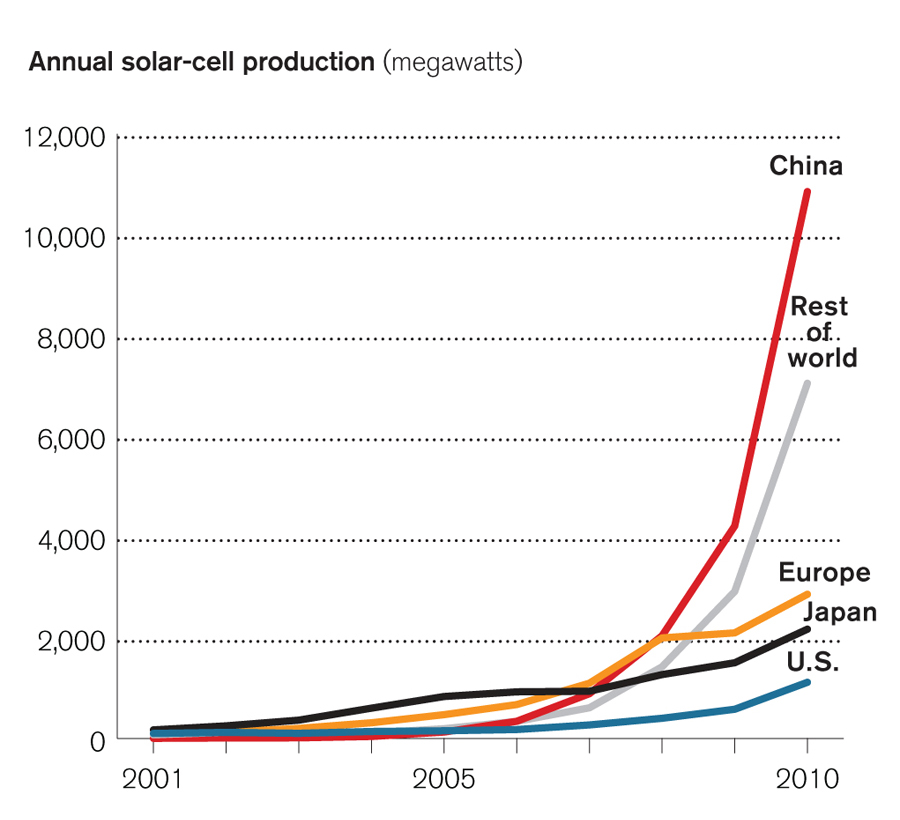
So will Gigafactories help make solar panels cheaper? Yes, but only once - and it already happened. The solar panel gigafactories were built in China. I'm going to show you a chart now and let you guess when they were built:
 This huge build-out in industrial capacity is what drove down prices. However, there was over-investment (Over-investment in China?!?! Sacre bleu!) and the spot price of solar panels were driven below production costs, leading to massive losses. Now the butcher's bill is getting paid.
The #1 solar panel module maker in the world is Yingli, but they got there by selling their panels at a loss for the last four years, and now they're on the verge of bankruptcy. Baoding Tianwei, a State-owned firm in China that is a supplier to solar companies, has defaulted on its bonds, blaming the glut of supply in the solar market. These two firms are not alone, I'm sure.
There will be a retrenchment in the production of solar panels as firms exit the business. Supply will contract until it meets up with demand again and the producers are profitable. The steep price declines we have seen in the last ten years won't be totally reversed, but they won't be totally kept either. Not in the short term.
So is there hope for future price declines? Sure, as long as you keep your expectations modest. The Solar City-Silevo merger I mentioned earlier is basically a technology play, relying on Silevo's superior technology to improve solar efficiency at the same price as today's panels. That's a good thing, and the price per watt will fall from that. But we shouldn't expect exponential curves in this industry. It's going to be a long, hard, slog.
The takeoff of solar-plus-batteries has only begun to ramp up the exponential curveI don't think this is the correct point of view. There is only one technology which is riding an exponential curve, and that's the miniaturization of electronics. Each time the feature size of a chip or memory register shrinks, the density of compute, memory and storage increases at an exponential rate. But most technologies don't work this way, and solar (despite being made from silicon) is not riding that curve.
Solar panels are a bulk-manufactured commodity. They aren't terribly hard to make; Elon Musk described them as being slightly simpler to make than drywall panels. And that's true. What's relevant to predicting the future of solar though is that no one predicts drywall panels to get 7% cheaper per year indefinitely. It's understood that their price is a function of their basic costs in terms of material, labor, and energy inputs, and that this can only be asymptotically approached, but not passed through (barring a technological substitute of some sort).
Batteries are similarly bulk-manufactured commodities. That's why Elon Musk isn't relying on Intel to deliver him cheaper batteries each year. He's building the Gigafactory instead because economies of scale are the only way to drive down bulk-manufactured commodity prices in the short-run. Technological price decreases happen at a much slower rate in this sector, when they happen at all. The same economies of scale are why Solar City bought Silevo and plan to product a 1 GW/year production plant in New York.
So will Gigafactories help make solar panels cheaper? Yes, but only once - and it already happened. The solar panel gigafactories were built in China. I'm going to show you a chart now and let you guess when they were built:
The #1 solar panel module maker in the world is Yingli, but they got there by selling their panels at a loss for the last four years, and now they're on the verge of bankruptcy. Baoding Tianwei, a State-owned firm in China that is a supplier to solar companies, has defaulted on its bonds, blaming the glut of supply in the solar market. These two firms are not alone, I'm sure.
There will be a retrenchment in the production of solar panels as firms exit the business. Supply will contract until it meets up with demand again and the producers are profitable. The steep price declines we have seen in the last ten years won't be totally reversed, but they won't be totally kept either. Not in the short term.
So is there hope for future price declines? Sure, as long as you keep your expectations modest. The Solar City-Silevo merger I mentioned earlier is basically a technology play, relying on Silevo's superior technology to improve solar efficiency at the same price as today's panels. That's a good thing, and the price per watt will fall from that. But we shouldn't expect exponential curves in this industry. It's going to be a long, hard, slog.
Tuesday, May 19, 2015
21 -- Part 2
My thinking on 21 has evolved a little bit over the first 24 hours. I'm going to lay out three scenarios for how I see the possibilities here.
First, to recap -
Subsidies, Revenue Sharing. This is the bait. Manufacturing electronics is a famously low-margin business. Margins on RAM or chips are razor-thin, and the ability to eek out even another 1% of margin will be leapt at. The sales pitch here is easy for getting the chip included in devices. "Hey, manufacturers, how would you like to earn a perpetual revenue stream from your devices?" It's almost free money to them.
With fast manufacturer and distribution uptake, consumers will end up with devices with this functionality whether they want it or not. It'll just be there, and the revenue splitting will be done by 21 (not the device). Even if there are ways for consumers to turn it off or modify the functionality (likely requiring jail-breaking the device), most won't.
Meanwhile consumers will see higher electric bills, but probably not so much higher they'll really care. They'll just see a status indicator that they have 50 Satoshis in their wallet, or whatever.
Priming the Pump: With fast manufacturer and distribution inclusion, and a 2-3 year upgrade cycle in mobile phones, we could have 21 BitShare chips in every mobile device in the world within a couple years. This lays the groundwork for massive developer support of the new features this allows.
However, for that to happen, 21 needs to protect the consumer's revenue split from greedy manufactures and distributors. If the manufacturer can take 100% of the Satoshis that aren't taken by 21, then the end-user gets nothing, and the potential for having automatic BTC just magically appear in their hardware wallet evaporates.
This leads to three scenarios:
GOOD
21 sees the opportunity to be the "AOL CD" of Bitcoin. Back in the 1990s average folks didn't know what the Internet was, or what it was for, or why they needed it, and it was hard for AOL to market their product, so their solution was to rain down Biblical plagues worth of free trial CDs on the people. Literally everyone in America ended up with a free trial CD (or a dozen of them) whether they wanted one or not, and a number of them put it into their computer on a "Why the hell not?" basis.
This could be a similar situation. Because of the financial incentive to manufacturers to include the 21 BitShare chip in every device, the public gets BTC on their mobile devices whether they want any or not. And each week or month a few of them will start using them on the same "Why not?" basis. This strategy is about getting BTC in front of as many people as possible to bootstrap Bitcoin to being the global financial protocol its boosters claim it's capable of being.
This scenario accepts that people won't voluntarily buy phones with BTC and load them up with Satoshis, mostly due to a lack of consumer education, but believes that the value is there if they can just get people to use it. Obviously this depends on the authentication and smart contract value of having a few Satoshis on hand actually being valuable to consumers. Because if it isn't, all they get is costs.
EVIL
21 sees the opportunity to control a very large mining pool, and they're offering a cut of those profits to all manufacturers and distribution channels, and getting unsuspecting consumers to pay for it with "free" electricity. This way 21 can undercut the mining cost structure of all the other professional miners who have an electric bill they need to pay.
Consumers get a slightly cheaper device (maybe), but there's no minimum reward-split for the end-user; all they get out of this scenario is slightly higher electric bills. The smart contracts features never appear, or they appear but the manufacturer takes 100% of the BTC earned, so the end-user never has any BTC to sign smart contracts with. There's no benefit to end-users here. It's hoped by 21 that the electric bill cost bump will be low enough to be a "tolerable annoyance", rather than something painful enough for consumers to revolt over.
NECESSARY EVIL
This scenario recognizes that both the GOOD and EVIL scenarios are real, but the EVIL scenario is seen as an intermediate stage to a future where consumers become educated about Bitcoins, want Bitcoins, and demand devices that share the majority of their mining rewards with the end-user, and not the distribution channel or even with 21. Also the mining chip eventually takes a back seat to the real feature that allows IoT commerce - hardware wallets in everything.
This scenario also contemplates that 21 won't be able to stamp out all other miners, so we don't have to worry about a 51% attack in the network. If the strategy is successful, competitors will appear en masse. It's not like ASIC mining chips are hard to design. Compared to a CPU or GPU, they're dirt simple. Some Chinese firms will reverse engineer the features necessary to work with whatever standards 21 has developed, and will sell those chips at a pittance. The mining pools will be as fragmented as the companies selling these chips. The share of revenue going to the chip companies will be driven down to the minimum viable margin, and it only remains to be seen whether the lion's share of the rewards go to the distributors or the end-users. Ultimately we end up in a place where every device in the world contributes a little hashing power to securing the network, and a 51% attack is physically impossible even by adversaries as well funded as the US or Chinese governments.
BUT WHICH IS IT?
Heck if I know. Frankly, reading the launch blog post by the CEO of the company, I can't help but be dismayed by how poorly written it is and how many logical inconsistencies it contains. It's a very bad start, and suggests either that they're really disorganized and have no idea what they're doing, or are actively trying to deceive people. Or maybe they're just really, really bad at explaining themselves. Who knows. We will have to wait and see what sort of contracts they actually strike in the manufacturing sector.
First, to recap -
- 21 has built a single-core mining ASIC that can be embedded in any electronic or home appliance. So if your mobile phone is plugged in, fully charged, and on Wifi, it can do some hashing and contribute to a virtual mining pool operated by 21 (I'm assuming they have the sense to not run mining operations while you're out and about, killing battery life and using up your data). This will produce a small stream of Satoshis for the device's use.
- The 21 Chip's mining process would be most cost-efficient in appliances that need to generate heat anyway, such as slow-cookers or washing machines. The chip can just be part of the heating element. But would Satoshis in your rice cooker be useful? I would think they'd be most useful in interactive devices such as your phone, tablet, home PC, or smart TV, so the economics are worse.
- The 21 Chip's mining process will never be as efficient as running your own (or hosted) mining rig in a low-cost electricity market, because of revenue splitting and local variance in the cost of electricity. Essentially you're spending $4 in electricity to get $1 in BTC. The $3 is the "cost" of having automatic, embedded Bitcoin in all of your devices. Convenience over frugality.
- Revenue splitting isn't just between the user and 21, but also allows for payments to be made to the manufacturer the chip is in, as well as the distribution channel. 21 specifically mentions the ability for retailers or mobile carriers to configure the 21 Chips they sell such that they earn BTC over time from a user's mining activity. The actual revenue split isn't disclosed. Does 21 guarantee a minimum share of income to the end-user? That's not clear.
- There is the possibility that devices will be able to use their Satoshis for authentication and identification. Of all the features mentioned in the 21's blog post, this is the only one that promises any real value to consumers.
Well, at 21 we are less concerned with bitcoin as a financial instrument and more interested in bitcoin as a protocolAnd this:
Crucial to this is the idea that bitcoin generated by embedded mining is more convenient — and hence more valuable — than bitcoin bought at market price and manually moved over to the site of utility.
These statements seem to concede my point #3 above, which is that the BTC generated by these devices will be peanuts-small and obscenely expensive compared to just running a mining rig. How much can a mobile carrier really make off of a cheap smartphone in the developing world? A couple dollars per year, at most? That's hardly enough to meaningfully defray the costs of a new electronic device.
I take them at their word that they consider BTC more useful as a protocol than as a financial instrument. Especially at the Satoshi price level! But what to make of all the space they spend on making arguments about payment streams or making micro-payments for things? Would the average user even care about the ability to buy, mayyyybe, one free song per month from their mining rewards? I have my doubts.
Meanwhile, this quote indicates a deeper purpose, about changing the basic fabric of computing:
Conceptually, we believe that embedded mining will ultimately establish bitcoin as a fundamental system resource on par with CPU, bandwidth, hard drive space, and RAM.And:
Towards that end, our team of PhDs in EE from MIT, Stanford, and CMU has built not just a chip, but a full technology stack around the chip — including reference devices, datasheets, a cloud backend, and software protocols.So here's what I think: I think we are looking at a classic bait & switch, but I'm not sure yet whether the intended patsy is the consumer or the manufacturing sector. Which one it will determine whether 21 is a "good" company or an "evil" one.
Subsidies, Revenue Sharing. This is the bait. Manufacturing electronics is a famously low-margin business. Margins on RAM or chips are razor-thin, and the ability to eek out even another 1% of margin will be leapt at. The sales pitch here is easy for getting the chip included in devices. "Hey, manufacturers, how would you like to earn a perpetual revenue stream from your devices?" It's almost free money to them.
With fast manufacturer and distribution uptake, consumers will end up with devices with this functionality whether they want it or not. It'll just be there, and the revenue splitting will be done by 21 (not the device). Even if there are ways for consumers to turn it off or modify the functionality (likely requiring jail-breaking the device), most won't.
Meanwhile consumers will see higher electric bills, but probably not so much higher they'll really care. They'll just see a status indicator that they have 50 Satoshis in their wallet, or whatever.
Priming the Pump: With fast manufacturer and distribution inclusion, and a 2-3 year upgrade cycle in mobile phones, we could have 21 BitShare chips in every mobile device in the world within a couple years. This lays the groundwork for massive developer support of the new features this allows.
However, for that to happen, 21 needs to protect the consumer's revenue split from greedy manufactures and distributors. If the manufacturer can take 100% of the Satoshis that aren't taken by 21, then the end-user gets nothing, and the potential for having automatic BTC just magically appear in their hardware wallet evaporates.
This leads to three scenarios:
GOOD
21 sees the opportunity to be the "AOL CD" of Bitcoin. Back in the 1990s average folks didn't know what the Internet was, or what it was for, or why they needed it, and it was hard for AOL to market their product, so their solution was to rain down Biblical plagues worth of free trial CDs on the people. Literally everyone in America ended up with a free trial CD (or a dozen of them) whether they wanted one or not, and a number of them put it into their computer on a "Why the hell not?" basis.
This could be a similar situation. Because of the financial incentive to manufacturers to include the 21 BitShare chip in every device, the public gets BTC on their mobile devices whether they want any or not. And each week or month a few of them will start using them on the same "Why not?" basis. This strategy is about getting BTC in front of as many people as possible to bootstrap Bitcoin to being the global financial protocol its boosters claim it's capable of being.
This scenario accepts that people won't voluntarily buy phones with BTC and load them up with Satoshis, mostly due to a lack of consumer education, but believes that the value is there if they can just get people to use it. Obviously this depends on the authentication and smart contract value of having a few Satoshis on hand actually being valuable to consumers. Because if it isn't, all they get is costs.
EVIL
21 sees the opportunity to control a very large mining pool, and they're offering a cut of those profits to all manufacturers and distribution channels, and getting unsuspecting consumers to pay for it with "free" electricity. This way 21 can undercut the mining cost structure of all the other professional miners who have an electric bill they need to pay.
Consumers get a slightly cheaper device (maybe), but there's no minimum reward-split for the end-user; all they get out of this scenario is slightly higher electric bills. The smart contracts features never appear, or they appear but the manufacturer takes 100% of the BTC earned, so the end-user never has any BTC to sign smart contracts with. There's no benefit to end-users here. It's hoped by 21 that the electric bill cost bump will be low enough to be a "tolerable annoyance", rather than something painful enough for consumers to revolt over.
NECESSARY EVIL
This scenario recognizes that both the GOOD and EVIL scenarios are real, but the EVIL scenario is seen as an intermediate stage to a future where consumers become educated about Bitcoins, want Bitcoins, and demand devices that share the majority of their mining rewards with the end-user, and not the distribution channel or even with 21. Also the mining chip eventually takes a back seat to the real feature that allows IoT commerce - hardware wallets in everything.
This scenario also contemplates that 21 won't be able to stamp out all other miners, so we don't have to worry about a 51% attack in the network. If the strategy is successful, competitors will appear en masse. It's not like ASIC mining chips are hard to design. Compared to a CPU or GPU, they're dirt simple. Some Chinese firms will reverse engineer the features necessary to work with whatever standards 21 has developed, and will sell those chips at a pittance. The mining pools will be as fragmented as the companies selling these chips. The share of revenue going to the chip companies will be driven down to the minimum viable margin, and it only remains to be seen whether the lion's share of the rewards go to the distributors or the end-users. Ultimately we end up in a place where every device in the world contributes a little hashing power to securing the network, and a 51% attack is physically impossible even by adversaries as well funded as the US or Chinese governments.
BUT WHICH IS IT?
Heck if I know. Frankly, reading the launch blog post by the CEO of the company, I can't help but be dismayed by how poorly written it is and how many logical inconsistencies it contains. It's a very bad start, and suggests either that they're really disorganized and have no idea what they're doing, or are actively trying to deceive people. Or maybe they're just really, really bad at explaining themselves. Who knows. We will have to wait and see what sort of contracts they actually strike in the manufacturing sector.
Subscribe to:
Posts (Atom)